
Bhakti Virtual Seva Portal

Your Digital Spiritual Companion

This humble Digital Seva Initiative has been created to support your Vaiyaktika Sadhana throughout the year. While it serves to inspire, guide, and strengthen your spiritual journey every single day.May this humble offering inspire regularity, deepen devotion, strengthen faith, and bring peace, joy, and spiritual progress to every Sadhaka. May your spiritual journey continue with Shraddha and Niyam

Darshan & Contemplation

A peaceful window for daily focus, meditation, and quiet morning prayer
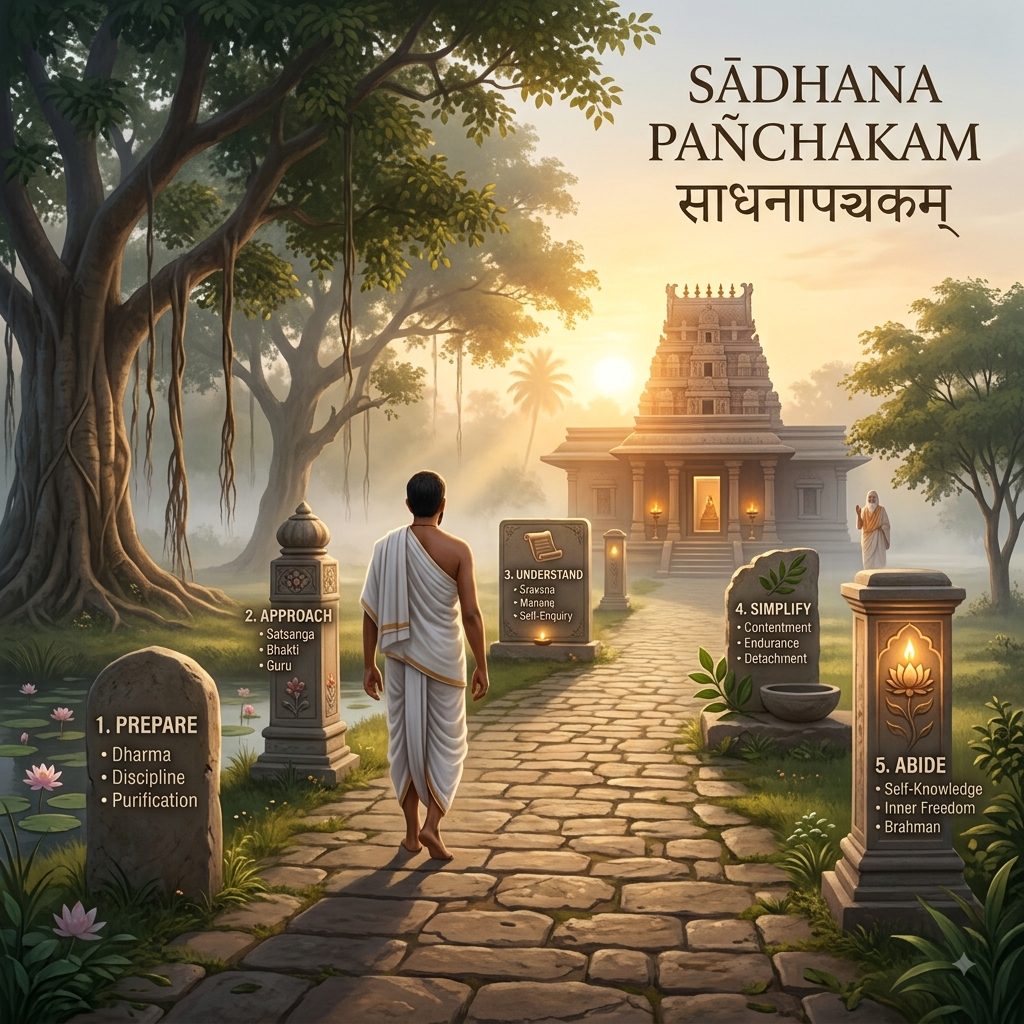
Sādhana Pañchakam

A Five-Day Journey of Sādhana

The Guru shows us the direction. Sādhana Pañchakam shows us how to walk the path.
Attributed to Ādi Śaṅkarācārya, Sādhana Pañchakam is a concise and profound teaching consisting of five verses containing forty spiritual injunctions for the life of a seeker. Yet we need not approach it as a list of forty things to accomplish.
For BVSP, we will first experience its wisdom gently—one verse each day for five days.
Each day, pause for a few quiet minutes with the verse, its meaning, its life application and its reflection.

The Five-Day Journey

Day 1 — Prepare - Begin by bringing knowledge, duty, devotion and self-discipline into life.

Day 2 — Approach - Cultivate Satsanga, Bhakti and the attitude of approaching the Guru.

Day 3 — Understand - Reflect upon the teaching and gradually remove false identification.

Day 4 — Simplify - Learn contentment, endurance, restraint and inner independence.

Day 5 — Abide - Turn inward and contemplate upon the Self as the Supreme Reality.

🪔 A Gentle Invitation

Do not hurry. Read slowly. Reflect quietly. Take one thought with you into the day. Sādhana is not about completing a list. It is about allowing one truth to transform the way we live. After the five-day journey, those who wish to explore further will be invited to discover the deeper dimension of Sādhana Pañchakam.
Five verses. Forty injunctions. One journey inward.

Sādhana Pañchakam


VERSE 1


वेदो नित्यमधीयतां तदुदितं कर्म स्वनुष्ठीयताम् ।
तेनेशस्य विधीयतामपचितिः काम्ये मतिस्त्यज्यताम् ।
पापौघः परिधूयतां भवसुखे दोषोऽनुसन्धीयताम् ।
आत्मेच्छा व्यवसीयतां निजगृहात्तूर्णं विनिर्गम्यताम् ॥१॥


LITERAL TRANSLATION


Study the sacred scriptures regularly. Perform the duties prescribed by them sincerely. Offer every action as worship to the Lord and give up selfish desires. Purify yourself from accumulated wrong actions. Reflect upon the limitations of worldly pleasures and cultivate a deep longing for Self-realization.


LIFE APPLICATION


Spiritual growth begins with disciplined living. Regular study, sincere performance of our duties, selfless action and devotion gradually purify the mind. When we begin to recognize that worldly pleasures are temporary, our attention naturally turns towards lasting peace and inner fulfilment.Give up attachment to hearth and home.


DAILY REFLECTION


Am I giving some space every day to that which truly nourishes my inner life? Even amidst responsibilities, can I consciously perform one action today without selfish expectation and offer it to the Divine?


INSPIRATION


Great spiritual journeys begin with small daily disciplines


REFLECTION


We do not have to change our entire life in one day. One sincere prayer, one moment of mindful study, one selfless action and one attachment consciously released can become the beginning of profound transformation.


TODAY'S SANKALP


Choose one action today that you normally do for yourself, and consciously offer it to the Divine without expecting anything in return.


Sādhana Pañchakam


VERSE 2


सङ्गः सत्सु विधीयतां भगवतो भक्तिर्दृढाधीयताम् ।
शान्त्यादिः परिचीयतां दृढतरं कर्माशु सन्त्यज्यताम् ।
सद्विद्वानुपसर्प्यतां प्रतिदिनं तत्पादुका सेव्यताम् ।
ब्रह्मैकाक्षरमर्थ्यतां श्रुतिशिरोवाक्यं समाकर्ण्यताम् ॥२॥


LITERAL TRANSLATION


Seek the company of noble and wise people. Strengthen your devotion to the Lord. Cultivate qualities such as peace and self-control. Give up actions driven by selfishness and ego. Humbly approach an enlightened teacher, serve the Guru with reverence, and listen attentively to the great teachings of the Upanishads.


LIFE APPLICATION


Our surroundings influence our thoughts, habits and values. Satsanga gives the mind a higher direction, devotion purifies the heart, and the Guru provides guidance on the spiritual path. We grow when we remain humble enough to learn and sincere enough to practise what we have learned.


DAILY REFLECTION


“May I seek Satsanga, deepen my Bhakti, remain humble before the Guru, and listen with an open heart.


INSPIRATION


“Is my company, my devotion, and my attitude towards the Guru helping me grow spiritually?”


REFLECTION


We gradually become like the company we keep. Seek people, teachings and environments that awaken your better nature. A moment of Satsanga can plant a thought that continues to transform us long after the meeting has ended.


TODAY'S SANKALP


Today, consciously spend a few minutes with something that elevates your mind—a sacred text, Guru's teaching, prayer or the company of a spiritually minded person.


Sādhana Pañchakam


VERSE 3


वाक्यार्थश्च विचार्यतां श्रुतिशिरः पक्षः समाश्रीयताम् ।
दुस्तर्कात्सुविरम्यतां श्रुतिमतस्तर्कोऽनुसन्धीयताम् ।
ब्रह्मास्मीति विभाव्यतामहरहर्गर्वः परित्यज्यताम् ।
देहेऽहंमति रुज्यतां बुधजनैर्वादः परित्यज्यताम् ॥३॥


LITERAL TRANSLATION


Reflect deeply upon the meaning of the scriptures. Take firm refuge in the teachings of the Upanishads. Avoid fruitless arguments and use reasoning that supports scriptural wisdom. Contemplate constantly, "I am Brahman." Give up pride, loosen identification with the body, and avoid unnecessary debates.


LIFE APPLICATION


Reading spiritual texts is only the beginning. Their real value appears when their teachings transform our thoughts, attitudes and behaviour. Instead of using knowledge to prove ourselves right, we should use it to understand Truth, overcome ego and become more humble and balanced.


DAILY REFLECTION


Reading spiritual texts is only the beginning. Their real value appears when their teachings transform our thoughts, attitudes and behaviour. Instead of using knowledge to prove ourselves right, we should use it to understand Truth, overcome ego and become more humble and balanced.


INSPIRATION


Wisdom is not measured by how much we know, but by how deeply we live what we know


REFLECTION


Let every teaching make us a little more humble, every challenge a little more aware, and every interaction an opportunity to practise what we have learned.


TODAY'S SANKALP


Today, when you disagree with someone, pause before responding and choose understanding over the need to prove yourself right.


Sādhana Pañchakam


VERSE 4


क्षुद्व्याधिश्च चिकित्स्यतां प्रतिदिनं भिक्षौषधं भुज्यतां ।
स्वाद्वन्नं न तु याच्यतां विधिवशात् प्राप्तेन सन्तुष्यताम् ।
शीतोष्णादिविषह्यतां न तु वृथा वाक्यं समुच्चार्यताम् ।
औदासीन्यमभीप्स्यतां जनकृपानैष्ठुर्यमुत्सृज्यताम् ॥ ४ ॥


LITERAL TRANSLATION


Treat hunger as a medical condition to be managed rather than a source of indulgence; accept food as what is available and sufficient. Do not constantly seek tasty food, but remain content with what comes by circumstances. Endure pairs of opposites such as heat and cold. Avoid meaningless speech, cultivate inner detachment, and give up both dependence upon people's favour and harshness towards others.


LIFE APPLICATION


This verse teaches us to simplify our relationship with physical comfort, food, speech and the opinions of others. Contentment does not mean neglecting our needs; it means not allowing comforts and preferences to control our peace of mind. We can practise this in ordinary life by accepting what is available with gratitude, speaking thoughtfully, remaining balanced in discomfort, and reducing our dependence on praise or approval.


DAILY REFLECTION


How much of my peace depends upon getting things exactly the way I want them? Can I accept one small inconvenience today without complaint, and remain calm and grateful?


INSPIRATION


Spiritual strength grows when our happiness becomes less dependent on external circumstances.


REFLECTION


We cannot control heat and cold, praise and criticism, comfort and inconvenience—but we can learn how we respond to them. Contentment is not giving up life; it is freeing ourselves from the constant demand that life must happen our way.


TODAY'S SANKALP


Today, consciously accept one inconvenience without complaint and respond to it with patience, gratitude and equanimity.


Sādhana Pañchakam


VERSE 5


एकान्ते सुखमास्यतां परतरे चेतः समाधीयताम् ।
पूर्णात्मा सुसमीक्ष्यतां जगदिदं तद्बाधितं दृश्यताम् ।
प्राक्कर्म प्रविलाप्यतां चितिबलान्नाप्युत्तरैः श्लिष्यताम् ।
प्रारब्धं त्विह भुज्यतामथ परब्रह्मात्मना स्थीयताम् ॥ ५ ॥


LITERAL TRANSLATION


Sit happily in a quiet and conducive place and turn the mind towards the Supreme. Contemplate the fullness of the Self and recognize the limitations of the changing world. Let past actions be dissolved through the power of Self-knowledge, without becoming bound by new actions. Experience the results of prārabdha karma with equanimity and abide in the knowledge that the Self is none other than the Supreme Brahman.


LIFE APPLICATION


The culmination of sadhana is an inward journey. We continue to fulfil our responsibilities, but gradually stop allowing the changing world to define our inner identity. Through contemplation, Self-knowledge and detachment, we learn to witness life's experiences without being completely carried away by them. The goal is not to escape life, but to live it while remaining rooted in the awareness of the Self.


DAILY REFLECTION


Am I able to create even a few quiet moments each day to turn inward? When life changes around me, can I remember that my deepest identity is greater than my circumstances?


INSPIRATION


The journey of sadhana ultimately turns us inward—from changing circumstances to the unchanging Self


REFLECTION


We need not withdraw from our responsibilities or run away from life. We can live fully, perform our duties and experience life's ups and downs while gradually discovering the stillness and fullness within.


TODAY'S SANKALP


Spend five quiet minutes today in silence, turn your attention inward, and simply observe the mind without trying to change anything.


Sādhana Pañchakam


Complete Module Summary


Five Verses • Forty Instructions 
One Spiritual Journey


Five Verses • Forty Instructions • One Spiritual Journey

Sadhana Panchakam, attributed to Jagadguru Adi Shankaracharya, is remarkable because five compact verses unfold a progressive roadmap for spiritual life. Each verse contains eight instructions, making forty practical directions for the seeker. The teaching begins with disciplined study, righteous action and purification; moves through Satsanga, devotion, Guru-seva and scriptural enquiry; then calls the seeker towards humility, freedom from ego and unnecessary argument. It continues with contentment, moderation, equanimity and detachment, and finally turns the seeker inward towards contemplation of the Self.

The beauty of Sadhana Panchakam is that these are not merely philosophical ideas. They are invitations to transform ordinary life into spiritual practice. Study becomes Sadhana. Work becomes worship. Satsanga becomes nourishment. Silence becomes reflection. Contentment becomes freedom. And Self-knowledge becomes the ultimate goal.

The five verses therefore form a progressive spiritual ladder—from disciplined living to purification, from purification to knowledge, and from knowledge to abiding in the Self.


The Five-Day Journey in One Line


Day 1 — Discipline: Build the foundation through study, duty, devotion and purification.

Day 2 — Satsanga: Elevate the mind through noble company, devotion and Guru's guidance.

Day 3 — Wisdom: Transform knowledge into understanding through reflection and humility.

Day 4 — Equanimity: Become less dependent on comfort, approval and changing circumstances.

Day 5 — Self-Knowledge: Turn inward and abide in the awareness of the Supreme Self.


40 profound spiritual injunctions.

These are not merely philosophical statements. They are practical directions for living a life of discipline, devotion, enquiry, detachment and inner growth.

We deliberately did not introduce these 40 injunctions during the five-day journey.

First, we wanted to see the whole path.

Now, we are ready to explore the individual steps.

Take a moment today and reflect:

Which of the five teachings touched you most?

Tomorrow, BVSP opens the door to the 40 injunctions of Sādhana Pañcakam.

From understanding the path… to walking the path.


Sādhana Pañchakam


One-Line Essence


Five Verses • Forty Instructions • One Spiritual Journey

Sadhana Panchakam is a practical ladder from disciplined living to inner purification, Self-knowledge and spiritual freedom.

One-Line Inspiration

Do not merely read the forty instructions—choose one, practise it, and let the teaching gradually transform the way you live.

Closing Reflection

The real completion of Sadhana Panchakam is not reaching the end of five verses; it is beginning to live them. We need not attempt all forty instructions at once. A sincere sadhaka can choose one teaching, practise it consciously, and return to it again and again. In time, what begins as a discipline becomes a habit, what becomes a habit shapes character, and what shapes character gradually transforms the inner life.

The journey ends on the page—but the Sadhana begins in life.


5 VERSES - 40 INJUNCTIONS


Together, they present 40 profound spiritual injunctions—practical directions for the life of a Sādhaka.

We have deliberately kept these out of the daily journey so that the experience remains simple and contemplative.

But if your curiosity has been awakened...

there is a deeper journey waiting.

Tomorrow, BVSP will open the door to the Sādhana Pañcakam Deep Dive — The 40 Injunctions.


Sādhana Pañchakam


Deep-Dive 40 Injunctions


VERSE 1 — Eight Injunctions 1 - 8


1. वेदो नित्यमधीयताम्
Study the scriptures regularly.

2.तदुदितं कर्म स्वनुष्ठीयताम्
Perform the duties prescribed by them sincerely.

3. तेनेशस्य विधीयताम् अपचितिः
Offer those actions as worship to the Lord.

4.काम्ये मतिः त्यज्यताम्
Give up attachment to desire-driven actions.

5.पापौघः परिधूयताम्
Purify yourself from accumulated wrongdoing.

6. भवसुखे दोषः अनुसन्धीयताम्
Reflect upon the limitations of worldly pleasures.

7.आत्मेच्छा व्यवसीयताम्
Firmly cultivate the desire for Self-realisation.

8. निजगृहात् तूर्णं विनिर्गम्यताम्
Gradually withdraw from worldly attachment and entanglement.

Essence: Prepare yourself for the spiritual journey.


Eight Injunctions 1 - 8


Inspiration — Prepare Yourself

The spiritual journey begins with preparation.

These first eight injunctions guide us to study the scriptures, perform our duties sincerely, offer our actions to the Lord, and gradually release our dependence on desire-driven pursuits. They invite us to recognise the limitations of worldly pleasures and awaken a deeper longing for Self-realisation.

Even withdrawing from worldly entanglement is not an escape from life. It is a gradual shift in where we seek fulfilment.

The message is simple: before seeking the highest Truth, prepare the mind, purify the heart, and clarify what you truly seek.


Today’s Action:
Choose one daily activity today and consciously perform it as an offering to the Lord, without seeking personal reward.

Reflection:

Am I living in a way that prepares my mind for Self-knowledge? Essence: Find Satsanga, deepen Bhakti, approach the Guru and receive the teaching.


Sādhana Pañchakam


Deep-Dive 40 Injunctions


VERSE 2 — Eight Injunctions 9  - 16


9. सङ्गः सत्सु विधीयताम्
Seek the company of the wise and noble.

10.भगवतो भक्तिः दृढा आधीयताम्
Cultivate firm devotion to the Lord.

11. शान्त्यादिः परिचीयताम्
Cultivate inner qualities such as peace and tranquillity.

12. दृढतरं कर्म आशु सन्त्यज्यताम्
Gradually renounce actions that are no longer conducive to spiritual growth.

13. सद्विद्वान् उपसृप्यताम्
Approach a wise and competent teacher.

14. प्रतिदिनं तत्पादुका सेव्यताम्
Serve the Guru's pādukās daily.

15. ब्रह्मैकाक्षरम् अर्थ्यताम्
Seek the knowledge of the imperishable Brahman, symbolised by Om.

16. श्रुतिशिरोवाक्यं समाकर्ण्यताम्
Listen deeply to the teachings of the Upanishads.

Essence: Find Satsanga, deepen Bhakti, approach the Guru and receive the teaching.

Prepare yourself for the spiritual journey.


Inspiration — From Association to Awakening


We become deeply influenced by the company we keep, the thoughts we repeatedly entertain, and the teachings we sincerely receive.  These eight injunctions invite us to consciously choose our inner environment: seek the company of the wise, strengthen devotion, cultivate peace, approach the Guru, serve with humility, and listen deeply to the wisdom of the Upanishads.

Spiritual growth is not merely about doing more. It is about becoming more inwardly prepared to receive the Truth.

Today’s Action

Spend a few quiet moments asking: What company, thoughts, and influences are shaping my inner life?

Reflection:
Am I creating the inner space in which the Guru’s teaching can truly take root?

Essence:   Find Satsanga, deepen Bhakti, approach the Guru and receive the teaching.


Sādhana Pañchakam

Deep-Dive 40 Injunctions


VERSE 3 — Eight Injunctions 17  - 24


17.वाक्यार्थः च विचार्यताम्
Reflect deeply upon the meaning of the Upanishadic
teachings.

18.श्रुतिशिरःपक्षः समाश्रीयताम्
Take refuge in the vision of the Upanishads.

19.दुस्तर्कात् सुविरम्यताम्
Give up faulty or misleading reasoning.

20.श्रुतिमतः तर्कः अनुसन्धीयताम्
Use reasoning that is consistent with the scriptural teaching.

21. ब्रह्मास्मि इति विभाव्यताम्
Contemplate: “I am Brahman.”

22. अहरहः गर्वः परित्यज्यताम्
Give up pride and arrogance day after day.

23. देहे अहम् मतिः उज्झ्यताम्
Give up the identification: “I am the body.”

24. बुधजनैः वादः परित्यज्यताम्
Give up argumentative debate with wise people.


Essence:

"Understand the teaching, remove false identification and become humble."

This is one of the most important corrections from our earlier list.
The Sanskrit explicitly says अहरहर्गर्वः — “day after day, give up pride/arrogance.”

Essence: Prepare yourself for the spiritual journey.


Inspiration — From Understanding to Humility


Spiritual study is not complete when we understand the words. We must allow the teaching to transform the way we see ourselves and the world.

Reflect deeply on the meaning of the Upanishadic teachings. Let their vision become the foundation of your understanding. When questions arise, use reasoning that supports the teaching rather than reasoning that merely creates doubt or argument.

Then comes the most profound contemplation:

“Brahmāsmi — I am Brahman.”

But this understanding must not become another reason for pride.

True knowledge gradually removes arrogance. It loosens our identification with the body, our attachment to the limited sense of “I”, and our need to prove ourselves right.

The deeper our understanding becomes, the more humble we should become.

We do not need to win every argument. We do not need to display what we know.

The purpose of knowledge is not to make the ego bigger, but to make the false identification smaller.

Today, let knowledge express itself as humility.

Essence: Find Satsanga, deepen Bhakti, approach the Guru and receive the teaching.


Sādhana Pañchakam

Deep-Dive 40 Injunctions


VERSE 4 — Eight Injunctions 25  - 32


25. क्षुद्व्याधिः च चिकित्स्यताम्
Treat hunger as a condition to be managed, rather than a source of indulgence.

26. प्रतिदिनं भिक्षौषधं भुज्यताम्
Take food simply, as medicine for the body.

27. स्वाद्वन्नं न तु याच्यताम्
Do not seek food merely for taste.

28.विधिवशात् प्राप्तेन सन्तुष्यताम्
Be content with what comes by the dispensation of Providence.

29. शीतोष्णादि विषह्यताम्
Endure heat, cold and other pairs of opposites.

30. न तु वृथा वाक्यं समुच्चार्यताम्
Avoid unnecessary and wasteful speech.

31.औदासीन्यम् अभीप्स्यताम्
Cultivate inner detachment and equanimity.

32. जनकृपा नैष्ठुर्यम् उत्सृज्यताम्
Give up dependence upon people's favour and the emotional pull of their kindness or harshness.

Essence:
Live simply, speak thoughtfully, remain balanced and inwardly independent.

There is a nuance here: some translations render the final phrase as avoiding dependence on people's kindness; others emphasise remaining unaffected by people's favour or harshness.

Some  prefer the broader and safer interpretation: do not become dependent upon or emotionally bound by people's favour or harshness.

Essence: Find Satsanga, deepen Bhakti, approach the Guru and receive the teaching.

Essence: Prepare yourself for the spiritual journey.


Inspiration — From Attachment to Inner Freedom


As our understanding deepens, the next step is to examine what holds the mind back.

The world will continue to offer pleasures, possessions, recognition and countless distractions. The teaching does not ask us to run away from life. It asks us to understand the limitations of depending upon external things for lasting happiness.

Let us therefore cultivate vairāgya — a quiet freedom from excessive attachment.

When desires arise, observe them rather than becoming their servant. When circumstances change, learn to remain steady. When praise or blame comes, do not allow either to determine your sense of worth.

A Sādhaka gradually discovers that peace is not something to be collected from outside.

It is revealed when the mind becomes free from unnecessary dependence.

Detachment is not rejection of life. It is freedom from being controlled by life.

The more we release what we do not truly need, the more space we create for contemplation, devotion and Self-knowledge.

Today, ask yourself:

What am I holding on to that is preventing inner freedom?

Let go a little more. Become a little freer.

Essence: Find Satsanga, deepen Bhakti, approach the Guru and receive the teaching.


Sādhana Pañchakam

Deep-Dive 40 Injunctions


VERSE 4 — Eight Injunctions 33  - 40


33. एकान्ते सुखम् आस्यताम्
Spend time happily in solitude.

34. परतरे चेतः समाधीयताम्
Absorb the mind in the Supreme Reality.

35.पूर्णात्मा सुसमीक्ष्यताम्
Clearly recognise the Self as whole and complete.

36.जगदिदं तद्बाधितं दृश्यताम्
Recognise the dependent/limited nature of the world in the light of the Self.

37. प्राक्कर्म प्रविलाप्यताम् चितिबलात्
Let accumulated past karma be dissolved through the power of Self-knowledge.

38. न आपि उत्तरैः श्लिष्यताम्
Do not become bound by future actions.

39. प्रारब्धं तु इह भुज्यताम्
Experience and exhaust the Prārabdha karma that has already begun to bear fruit.

40. अथ परब्रह्मात्मना स्थीयताम्
Ultimately, abide as the Supreme Brahman, the Self.

Essence:

Abide in Self-knowledge and live in freedom.

The Sanskrit source explicitly identifies these as the final eight instructions, and the traditional explanation connects them with Sanchita, Agami and Prārabdha karma

Prepare yourself for the spiritual journey.


Inspiration — From Practice to Abidance


The journey now turns inward.

Spiritual knowledge becomes meaningful only when it becomes a way of living. The Sādhaka must repeatedly return to the teaching, contemplate it, and allow it to settle deeply within.

There will be distractions. There will be old habits. There will be moments of doubt and moments when the mind wanders. Do not be discouraged.

Return to the teaching.

Return to contemplation.

Return to the awareness of the Self.

Gradually, the understanding that was once an idea becomes a lived conviction. The search for happiness outside begins to quieten, because we start recognising the fullness that is already within.

This is not about becoming someone extraordinary.

It is about removing what is false and abiding in what is true.

Sādhana is not merely something we do. Ultimately, it transforms the way we abide.

Let every day become an opportunity to remain established in the knowledge:

“I am not merely this limited body and mind. My true nature is the Self.”

Practice sincerely. Contemplate deeply. Abide quietly.

Five Verses • Forty Injunctions • One Lifelong Journey

One Day • One Reflection • One Sincere Step Towards the Guru

ॐ श्री गुरुभ्यो नमः।


Conclusion of Sādhana Pañchakam


From Knowing the Path to Living the Path


Five verses. Forty injunctions. One journey towards the Self.

We began our journey through Sādhana Pañcakam by looking at the larger path:

Prepare → Approach → Understand → Simplify → Abide

Then we opened the five verses more deeply and discovered 40 spiritual injunctions — not as a list to memorise, but as practical guidance for the life of a Sādhaka.

They teach us to discipline our lives, purify our minds, seek Satsaṅga, cultivate devotion, study the Śāstras, reflect deeply, use right reasoning, give up false identification, become humble, develop detachment and turn steadily towards Self-knowledge.

But there is an important lesson hidden in the entire journey:

Sādhana is not about collecting spiritual instructions.

It is about allowing those instructions to transform us.

Knowledge should make us humble.

Discipline should make us steady.

Devotion should make us sincere.

Detachment should make us free.

Contemplation should make us inward.

And Self-knowledge should gradually dissolve the false identification that keeps us from recognising our true nature.

The 40 injunctions therefore do not represent 40 tasks to complete.

They represent 40 opportunities to grow.

Some may immediately speak to us.
Some may challenge us.
Some may require years of practice.
And some may become meaningful only when life presents the right situation.

That is perfectly natural.

Essence: Prepare yourself for the spiritual journey.


Inspiration — Sādhana is a journey, not a checklist.


The true measure of our progress is not how many teachings we have read, but whether we are becoming a little more disciplined, a little less reactive, a little less attached, a little more humble, a little more compassionate and increasingly established in the truth of the Self.

The journey continues.

Sādhana Pañchakam does not end with the completion of this module.

It begins to live through us when we carry even one teaching into our day.

So let us not ask:

“Have I completed the 40 injunctions?”

Instead, let us ask:

“Which one can I sincerely practice today?”

One teaching.
One reflection.
One sincere step.

And, with continued practice, may these small steps gradually lead us from understanding the path to walking the path, and from walking the path to abiding in the Self.

May Sādhana Pañchakam become not merely something we studied, but something we live.

ॐ श्री गुरुभ्यो नमः।


Concluding Audio of Sādhana Pañchakam

From Knowing the Path to Living the Path