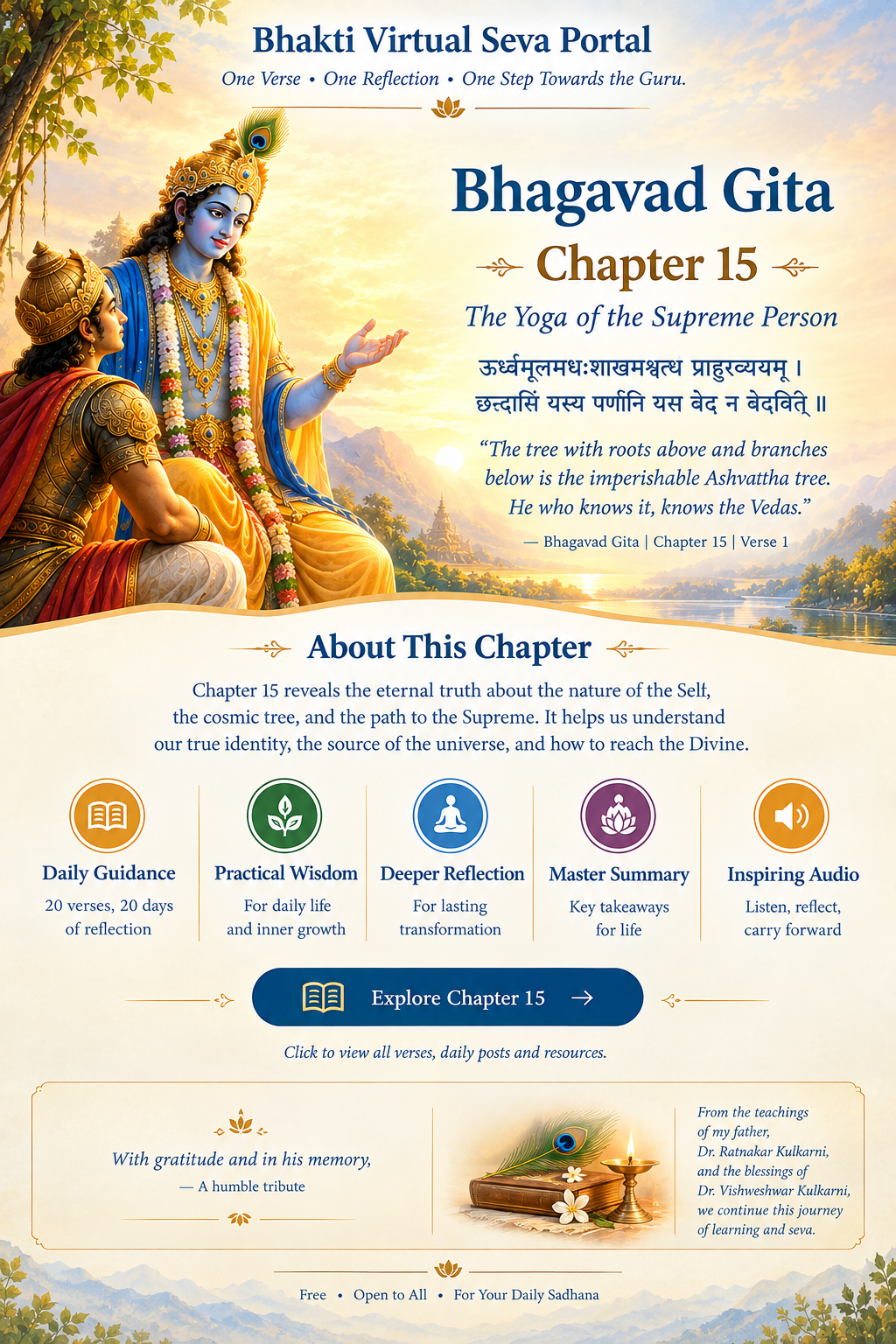
This humble Digital Seva Initiative has been created to support your Vaiyaktika Sadhana throughout the year. While it serves to inspire, guide, and strengthen your spiritual journey every single day.May this humble offering inspire regularity, deepen devotion, strengthen faith, and bring peace, joy, and spiritual progress to every Sadhaka. May your spiritual journey continue with Shraddha and Niyam
Shrīmad Bhagawadgītā
The Śrīmad Bhagawadgītā is a timeless dialogue between Bhagavān Śrī Kṛṣṇa and Arjuna, offering profound guidance for living with clarity, devotion and purpose. Through 18 chapters and 700 verses, it explores Karma, Jñāna, Bhakti and the path to inner freedom.
It teaches us how to perform our duties with sincerity, surrender the results and remain steady amidst life’s challenges. For the sādhaka, the Gītā is not merely a scripture to read, but a wisdom to contemplate and practice.
One Verse • One Reflection • One Step Towards the Guru.
Darshan & Contemplation
Shrīmad Bhagawadgītā
Chapter 15, Purushottama Yoga The Yoga of the Supreme Person
Beginning the Journey A Gentle Beginning - Welcome to Chapter 15 of the Bhagavad Gita — Purushottama Yoga, the Yoga of the Supreme Person. Before we begin with Verse 1, take a moment to pause.
Chapter 15 invites us to look at life from a deeper perspective — to understand the world in which we live, the Self within us, and the Supreme Reality towards which our journey leads.Over the coming days, we will not try to understand everything at once. We will take one verse at a time. Read it slowly. Listen to it. Reflect upon its meaning.And then ask yourself:
“How can I live this teaching today?”
That is the spirit in which we begin.
Why Does Chapter 15 Matter to a Daily Sādhaka?
From Study to Sadhana
Our everyday life is filled with responsibilities, relationships, choices, successes and difficulties. Yet beneath all of this is a deeper question: Who am I beyond all these changing experiences?
Chapter 15 begins with the powerful image of the Aśvattha tree — with its roots above and branches below — helping us look more deeply at worldly existence and our attachments to it. The chapter then takes us further: from the world around us to the individual Self to the Divine presence within us and ultimately to Purushottama — the Supreme Person
For a daily sādhaka, this chapter is not only philosophy to be understood. It is an invitation to see our own life differently — to become a little more aware, a little less attached, a little more centred, and a little closer to the Guru's teaching.
Our Approach in BVSP
From Study to Sadhana
As always, we follow a simple principle: One Verse • One Reflection • One Step Towards the Guru
We will not rush through the chapter.Each day, we will spend a few quiet minutes with one verse: Sanskrit Verse- The original śloka.
Transliteration To help you read and follow the Sanskrit.
Translation A simple understanding of the verse.
Life Application - How the teaching can gently connect with everyday life.
Inspiration -A thought to carry with you.
Today's Action - One small step to practise the teaching.
Reflection A question to take inward.
Guided Reflection A short audio to help you pause, reflect and carry the teaching into your day.
What to ExpectDays 1–20
One verse each day.Twenty verses. Twenty days.
Twenty opportunities to pause, reflect and practise. After completing the verses, we will step back and look at Chapter 15 as a whole — revisiting its central teachings and reflecting on what they mean for our own sādhana.
The purpose is not simply to say: “I completed Chapter 15. ”The deeper purpose is to ask:
“What has Chapter 15 changed in the way I see myself and my life?”
Before You Begin You do not need to know Sanskrit. You do not need to understand the entire Bhagavad Gita. You do not need to spend a long time every morning. Simply come with a quiet mind and a willingness to reflect. Take one verse. Take one thought. Take one small step. And return tomorrow. Let us begin.
śrī-bhagavān uvācaūrdhva-mūlam adhaḥ-śākham aśvatthaṁ prāhur avyayam chandāṁsi yasya parṇāni yas taṁ veda sa veda-vit
TRANSLATION
The Blessed Lord said:They speak of an imperishable Ashvattha tree, with its roots above and branches below, whose leaves are the Vedic hymns. One who knows this tree truly knows the Veda.
LIFE APPLICATION
We normally look at life from the outside. Family. Work. Relationships. Money. Responsibilities. Success. Failure. Krishna gives us a completely different picture. He describes existence as a tree whose roots are above and whose branches spread downward. Perhaps this is our first invitation in Chapter 15: Do not mistake the branches for the whole tree. What we see around us is only the visible expression of something much deeper.
INSPIRATION
We spend so much time managing the branches of life. Krishna invites us to discover the root.
TODAY'S ACTION
Whenever you face a problem today, ask:
“Am I dealing only with the visible branch, or am I looking for the root?”
REFLECTION
What occupies most of my attention—the branches of life or their deeper source?
SUMMARY AUDIO OF THE DAY
“Close your eyes, put on your headphones, and let the wisdom of today’s Sādhana gently settle into your heart.”
Its branches spread both downward and upward, nourished by the three guṇas, with sense objects as their tender shoots. Its roots also extend downward into the human world, binding beings through action.
LIFE APPLICATION
Our lives grow through repeated choices.A desire becomes an action. An action becomes a habit. A habit strengthens attachment. Attachment influences another action. Slowly, the branches become stronger. Krishna asks us to notice this process rather than simply blaming circumstances.
INSPIRATION
Every day we are watering something.The question is:What are we helping to grow?
TODAY'S ACTION
Notice one recurring desire or habit today. Don't fight it. Simply observe: What action does this desire usually lead me towards?
REFLECTION
Which habit in my life is becoming stronger because I keep feeding it?
SUMMARY AUDIO OF THE DAY
“Close your eyes, put on your headphones, and let the wisdom of today’s Sādhana gently settle into your heart.”
📖 Chapter 15 — पुरुषोत्तम योग
VERSE 3 — The Tree Cannot Be Fully Understood
न रूपमस्येह तथोपलभ्यते नान्तो न चादिर्न च सम्प्रतिष्ठा । अश्वत्थमेनं सुविरूढमूलम् असङ्गशस्त्रेण दृढेन छित्त्वा ॥ १५.३॥
TRANSLITERATION
na rūpam asyeha tathopalabhyate nānto na cādir na ca sampratiṣṭhā aśvattham enaṁ su-virūḍha-mūlam asaṅga-śastreṇa dṛḍhena chittvā
TRANSLATION
Its true form is not perceived here as such—neither its end, nor its beginning, nor its foundation. Having cut down this deeply rooted Ashvattha tree with the strong weapon of non-attachment...
LIFE APPLICATION
Krishna does not tell us that the answer is to understand every complexity of life intellectually. Instead, He points to asaṅga — non-attachment. We often try to solve inner problems by acquiring more information. But some bonds are not removed by information. They are loosened by non-attachment.
INSPIRATION
Non-attachment does not mean running away from life.It means: I participate fully, but I do not allow possession and attachment to possess me.
TODAY'S ACTION
Do one responsibility today wholeheartedly—but consciously let go of the need to control its outcome.
REFLECTION
What am I holding so tightly that it has begun to hold me?
SUMMARY AUDIO OF THE DAY
“Close your eyes, put on your headphones, and let the wisdom of today’s Sādhana gently settle into your heart.”
tataḥ padaṁ tat parimārgitavyaṁ yasmin gatā na nivartanti bhūyaḥ tam eva cādyaṁ puruṣaṁ prapadye yataḥ pravṛttiḥ prasṛtā purāṇī
TRANSLATION
Then one should seek that Supreme state from which those who have reached it do not return again. I surrender to that Primordial Person from whom this ancient activity of existence has flowed forth.
LIFE APPLICATION
After asking us to loosen attachment, Krishna does not leave us with emptiness. There is a higher destination. Spiritual life is not merely:“Give up this.”It is also:“Turn towards That.
”Renunciation becomes meaningful when it creates space for the Divine.
INSPIRATION
We cannot merely keep asking:“What should I let go of?”We must also ask:
“What am I moving towards?”
TODAY'S ACTION
Spend five quiet minutes today remembering the higher purpose of your life beyond immediate success and failure.
REFLECTION
What is the destination towards which my life is actually moving?
SUMMARY AUDIO OF THE DAY
“Close your eyes, put on your headphones, and let the wisdom of today’s Sādhana gently settle into your heart.”
📖 Chapter 15 — पुरुषोत्तम योग
VERSE 5 — The Qualities of Those Who Reach That State
Those who are free from pride and delusion, who have overcome the fault of attachment, who are ever devoted to the Self, whose desires have withdrawn, and who are freed from the pairs of opposites such as pleasure and pain—those undeluded ones reach that imperishable state.
LIFE APPLICATION
Krishna gives us a practical picture of spiritual maturity: Less pride. Less attachment. Less compulsive desire. Greater inner awareness. Greater steadiness through pleasure and pain. This is not a transformation that happens overnight. It is cultivated through daily sādhana.
INSPIRATION
Spiritual progress is not necessarily about becoming extraordinary.Perhaps it is about becoming less controlled by the things that once controlled us.
TODAY'S ACTION
Catch yourself once today when ego, attachment or desire begins to dictate your response.Pause.
REFLECTION
Which one is strongest in me today—pride, attachment, desire, or reaction to pleasure and pain?
SUMMARY AUDIO OF THE DAY
“Close your eyes, put on your headphones, and let the wisdom of today’s Sādhana gently settle into your heart.”
📖 Chapter 15 — पुरुषोत्तम योग
VERSE 6 — The Supreme Abode
न तद्भासयते सूर्यो न शशाङ्को न पावकः । यद्गत्वा न निवर्तन्ते तद्धाम परमं मम ॥ १५.६॥
TRANSLITERATION
na tad bhāsayate sūryo na śaśāṅko na pāvakaḥ yad gatvā na nivartante tad dhāma paramaṁ mama
TRANSLATION
Neither the sun nor the moon nor fire illumines that Supreme abode of Mine. Having reached it, they do not return.
LIFE APPLICATION
We normally depend upon external sources of light. Krishna points towards a reality that does not depend upon those external sources. At the spiritual level, we are invited to discover a light within that is not dependent upon circumstances.
INSPIRATION
External light helps us see the world.Spiritual wisdom helps us see ourselves.
TODAY'S ACTION
Before beginning your day, sit silently for one minute without your phone, without music and without any distraction. Simply be present.
REFLECTION
What remains within me when all external stimulation becomes quiet?
SUMMARY AUDIO OF THE DAY
“Close your eyes, put on your headphones, and let the wisdom of today’s Sādhana gently settle into your heart.”
The individual self in this world is verily a part of My own eternal being. Having become embodied, it draws towards itself the mind and the five senses, which belong to material nature.
LIFE APPLICATION
Krishna changes the question. Instead of asking only: “What do I possess?” we begin to ask:“Who am I?”
The body, mind and senses are instruments through which we experience life. But Krishna points to something deeper—the sanātana, the eternal dimension of the individual self.
INSPIRATION
You are not merely the roles you perform.Not merely a profession. Not merely a relationship. Not merely a success or failure.There is something deeper.
TODAY'S ACTION
At one moment today, notice your body, your thoughts and your emotions as things you are experiencing. Then quietly ask:
“Who is the one experiencing them?”
REFLECTION
If my body, thoughts and emotions are changing, what is the deeper “I” that witnesses them?
SUMMARY AUDIO OF THE DAY
“Close your eyes, put on your headphones, and let the wisdom of today’s Sādhana gently settle into your heart.”
When the embodied being obtains a body, and when it leaves it, it carries the mind and senses with it, just as the wind carries fragrances from their source.
LIFE APPLICATION
Krishna uses a simple image. We cannot see fragrance being carried by the wind, yet we know it is there. Similarly, the deeper journey of the individual self is not something we can understand merely through what the eyes see. This verse invites humility before realities that lie beyond ordinary perception.
INSPIRATION
Not everything that is real is visible.
TODAY'S ACTION
Today, whenever you find yourself saying “I don't see it, therefore it isn't there,” pause. Ask: “Could there be something beyond what I can presently perceive?”
REFLECTION
How much of reality do I assume is limited to what I can see, hear and measure?
SUMMARY AUDIO OF THE DAY
“Close your eyes, put on your headphones, and let the wisdom of today’s Sādhana gently settle into your heart.”
Chapter 15 — पुरुषोत्तम योग
VERSE 9 — The Self Experiences Through the Senses
श्रोत्रं चक्षुः स्पर्शनं च रसनं घ्राणमेव च । अधिष्ठाय मनश्चायं विषयानुपसेवते ॥ १५.९॥
TRANSLITERATION
śrotraṁ cakṣuḥ sparśanaṁ ca rasanaṁ ghrāṇam eva ca adhiṣṭhāya manaś cāyaṁ viṣayān upasevate
TRANSLATION
Presiding over the ear, eye, skin, tongue and nose, together with the mind, the embodied being experiences the objects of the senses.
LIFE APPLICATION
Our senses constantly pull our attention outward.A sound. A notification. A taste. A sight. A touch. A thought. The mind moves from one object to another. Sādhana begins when we become aware of this movement.
INSPIRATION
The problem is not that we have senses.The question is:Who is directing our attention?
TODAY'S ACTION
Choose one ordinary activity today—eating, walking or drinking tea. Do it without your phone. For one minute, simply observe the experience without distraction.
REFLECTION
How often am I choosing where my attention goes—and how often is something else choosing for me?
SUMMARY AUDIO OF THE DAY
“Close your eyes, put on your headphones, and let the wisdom of today’s Sādhana gently settle into your heart.”
The deluded do not perceive the embodied being when it departs, remains in the body, or experiences the objects of the guṇas. But those who possess the eye of knowledge perceive it.
LIFE APPLICATION
Two people can look at exactly the same event and see completely different things. The difference is not always in the event. It can be in the quality of vision. Krishna calls this jñāna-cakṣus — the eye of knowledge. Sādhana gradually changes not merely what we see, but how we see.
INSPIRATION
When something irritates or disappoints you today, pause and ask:“What am I not seeing because I am looking through my present conditioning?”
TODAY'S ACTION
Whenever you face a problem today, ask:
“Am I dealing only with the visible branch, or am I looking for the root?”
REFLECTION
Do I need a different situation—or a different way of seeing the situation?
SUMMARY AUDIO OF THE DAY
“Close your eyes, put on your headphones, and let the wisdom of today’s Sādhana gently settle into your heart.”
The striving yogis behold this Self abiding within themselves. But those who have not disciplined themselves, though they strive, do not perceive It because their minds are not refined.
LIFE APPLICATION
Krishna tells us something important about spiritual vision. It is not enough merely to try. We can read scriptures, listen to talks, attend programmes and perform practices. Yet the deeper vision develops only when the mind itself becomes prepared. The same Self is present, but our capacity to recognise it differs. It is like looking at something with distracted eyes. The object may be right in front of us, yet we fail to notice it. Sādhana therefore is not only about adding more practices.
It is about refining the person who performs them.
INSPIRATION
Perhaps the question is not:“How much spiritual material have I consumed?” but:
“What is my sādhana doing to me?”
TODAY'S ACTION
Do today's sādhana with complete attention for ten minutes. No phone. No multitasking. No rushing.
REFLECTION
Is my spiritual practice changing my inner quality—or am I simply collecting spiritual information?
SUMMARY AUDIO OF THE DAY
“Close your eyes, put on your headphones, and let the wisdom of today’s Sādhana gently settle into your heart.”
yad āditya-gataṁ tejo jagad bhāsayate 'khilam yac candramasi yac cāgnau tat tejo viddhi māmakam
TRANSLATION
The light that resides in the sun and illumines the entire world, the light that is in the moon and in fire—know that light to be Mine.
LIFE APPLICATION
We usually see the sun as simply the sun, fire as simply fire and moonlight as simply moonlight. Krishna asks us to look again. Behind the ordinary experiences of life, recognise the Divine presence. This changes the way we see the world. A sunrise is no longer merely beautiful. Light itself can become a reminder of the Divine. The verse does not ask us to reject the physical explanation of light. It invites us to see beyond the physical phenomenon—to recognise the Divine source and presence underlying existence.
INSPIRATION
The Divine does not have to be searched for only in extraordinary moments.Perhaps the ordinary world itself is constantly giving us reminders.
TODAY'S ACTION
When you see sunlight today, pause for a few seconds. Instead of merely seeing the light, remember: “This too is a reminder of Krishna.”
REFLECTION
How often do I move through the world without noticing the Divine presence within ordinary things?
SUMMARY AUDIO OF THE DAY
“Close your eyes, put on your headphones, and let the wisdom of today’s Sādhana gently settle into your heart.”
Entering the earth, I sustain all beings by My strength. Becoming the moon, which embodies nourishment and essence, I nourish all plants.
LIFE APPLICATION
We often think of life as something we manage ourselves. We eat. We work. We earn. We plan. We achieve. But how much of life is actually under our control? The earth gives us food. Plants grow. Nature sustains us. Our body functions through countless processes we did not design.
Krishna invites us to recognise this sustaining power.
INSPIRATION
There is something humbling about realising: I participate in life, but I do not create life.
TODAY'S ACTION
Before eating one meal today, pause for a few seconds. Remember the earth, the rain, the farmer, the plants—and the Divine sustaining the entire process.
REFLECTION
How much of what I receive every day do I take for granted?
SUMMARY AUDIO OF THE DAY
“Close your eyes, put on your headphones, and let the wisdom of today’s Sādhana gently settle into your heart.”
Becoming the Vaiśvānara fire dwelling in the bodies of living beings, and united with the incoming and outgoing breaths, I digest the four kinds of food.
LIFE APPLICATION
Krishna brings the Divine even closer. Not only the sun. Not only the earth. Not only something distant and transcendent. He is present within our own body. Something as ordinary as digestion becomes an opportunity to recognise the mysterious intelligence sustaining life. We eat our food, but we do not consciously digest it. We sleep, but we do not consciously keep our bodies functioning. Life continues within us without our constant command.
INSPIRATION
We spend so much time trying to control life. This verse reminds us of how much is already being taken care of.
TODAY'S ACTION
At one meal today, eat slowly for the first few minutes. Before beginning, silently offer gratitude for the life within you that receives and transforms that food.
REFLECTION
How much of the miracle of being alive do I notice each day?
SUMMARY AUDIO OF THE DAY
“Close your eyes, put on your headphones, and let the wisdom of today’s Sādhana gently settle into your heart.”
sarvasya cāhaṁ hṛdi sanniviṣṭo mattaḥ smṛtir jñānam apohanaṁ ca vedaiś ca sarvair aham eva vedyo vedānta-kṛd veda-vid eva cāham
TRANSLATION
I am seated in the heart of all beings. From Me arise memory, knowledge and their removal. I alone am to be known through all the Vedas; I am the author of Vedānta and the knower of the Veda.
LIFE APPLICATION
This verse takes us inward.Krishna says: “I am seated in the heart of all beings.” If we genuinely contemplate this, our relationship with other people can begin to change. The person in front of us is not merely a role, a status or a personality. There is a Divine presence within. This does not mean we ignore harmful behaviour or abandon discrimination.
It means that beneath our judgments, we remember a deeper spiritual reality.
INSPIRATION
What would change if, before reacting to another person, we remembered: “Krishna is seated in this heart too.”
TODAY'S ACTION
Before responding sharply to someone today, pause for three seconds. Remember this verse. Then respond.
REFLECTION
Can I recognise the Divine presence not only within myself, but also within the person I find difficult?
SUMMARY AUDIO OF THE DAY
“Close your eyes, put on your headphones, and let the wisdom of today’s Sādhana gently settle into your heart.”
dvāv imau puruṣau loke kṣaraś cākṣara eva ca kṣaraḥ sarvāṇi bhūtāni kūṭastho 'kṣara ucyate
TRANSLATION
There are two kinds of beings in this world: the perishable and the imperishable. All embodied beings are perishable, while the one that remains unchanging is called imperishable.
LIFE APPLICATION
We live surrounded by change.Our body changes. Our circumstances change. Relationships change. Possessions come and go. Even our thoughts and emotions continuously change. Yet we instinctively search for something permanent within this changing world. Krishna asks us to recognise the distinction between the perishable and the imperishable.
INSPIRATION
Much of our anxiety comes from trying to make the changing permanent. Perhaps wisdom begins when we accept: What changes will change.
TODAY'S ACTION
Notice three things today that are changing.Instead of resisting the change, simply acknowledge:“This belongs to the realm of the perishable.”
REFLECTION
What am I trying to hold permanently even though I know it is temporary?
SUMMARY AUDIO OF THE DAY
“Close your eyes, put on your headphones, and let the wisdom of today’s Sādhana gently settle into your heart.”
📖 Chapter 15 — पुरुषोत्तम योग
VERSE 17 — The Supreme Person
उत्तमः पुरुषस्त्वन्यः परमात्मेत्युदाहृतः । यो लोकत्रयमाविश्य बिभर्त्यव्यय ईश्वरः ॥ १५.१७॥
TRANSLITERATION
uttamaḥ puruṣas tv anyaḥ paramātmety udāhṛtaḥ yo loka-trayam āviśya bibharty avyaya īśvaraḥ
TRANSLATION
But distinct from these is the Supreme Person, spoken of as the Paramātman—the Supreme Self—who, entering the three worlds, sustains them as the imperishable Lord.
LIFE APPLICATION
Krishna now takes us beyond the distinction between the perishable and imperishable. There is the Supreme Person, the Paramātman, who sustains the entire universe. This reminds us that the Gita's teaching is not merely about self-improvement. It is about our relationship with the Supreme Reality. The purpose of sādhana is not simply to become a better-performing human being. It is to know the deeper reality and our relationship with it.
INSPIRATION
We often ask:“How can I improve myself?” The Gita gradually leads us towards a deeper question: “What is the Reality in which this ‘I’ exists?”
TODAY'S ACTION
Spend a few minutes today not asking Krishna for anything.Simply sit in remembrance.
REFLECTION
Can my relationship with the Divine be more than asking for what I want?
SUMMARY AUDIO OF THE DAY
“Close your eyes, put on your headphones, and let the wisdom of today’s Sādhana gently settle into your heart.”
yasmāt kṣaram atīto 'ham akṣarād api cottamaḥ ato 'smi loke vede ca prathitaḥ puruṣottamaḥ
TRANSLATION
Because I transcend the perishable and am also higher than the imperishable, I am therefore celebrated in the world and in the Veda as Purushottama, the Supreme Person.
LIFE APPLICATION
Krishna identifies Himself as Purushottama. This is an important moment in the chapter. The teaching is not simply: “Discover your inner strength.” It culminates in recognising Krishna as the Supreme Person. For the sādhaka, this means that spiritual knowledge and devotion come together. We enquire. We understand. We practise. And ultimately, we turn towards the Supreme.
INSPIRATION
The journey of knowledge does not take us away from devotion.True understanding can deepen devotion.
TODAY'S ACTION
Today, when you say or hear the name Krishna, pause for a moment and remember the meaning of Purushottama—the Supreme Person.
REFLECTION
Is my understanding of Krishna becoming deeper as my sādhana progresses?
SUMMARY AUDIO OF THE DAY
“Close your eyes, put on your headphones, and let the wisdom of today’s Sādhana gently settle into your heart.”
📖 Chapter 15 — पुरुषोत्तम योग
VERSE 19 — Knowing Purushottama
यो मामेवमसम्मूढो जानाति पुरुषोत्तमम् । स सर्वविद्भजति मां सर्वभावेन भारत ॥ १५.१९॥
TRANSLITERATION
yo mām evam asammūḍho jānāti puruṣottamam sa sarva-vid bhajati māṁ sarva-bhāvena bhārata
TRANSLATION
One who, free from delusion, knows Me thus as Purushottama knows the truth in its entirety and worships Me with his whole being, O Bhārata.
LIFE APPLICATION
Knowledge reaches its natural culmination in bhakti. Krishna does not say that knowing Him merely produces more intellectual knowledge. The person who truly recognises Him as Purushottama worships Him with the whole being.
This is a beautiful BVSP principle. Sādhana should gradually move from:
Reading → Understanding → Reflection → Living → Devotion.
If our understanding remains only in the head, something is incomplete.
INSPIRATION
The deepest knowledge is not merely something we can explain. It is something that changes the way we live.
TODAY'S ACTION
Take one teaching from Chapter 15 that has touched you.Ask:
“How can I live this today?” Then actually do one small thing.
REFLECTION
Is what I know about the Gita becoming visible in how I live?
SUMMARY AUDIO OF THE DAY
“Close your eyes, put on your headphones, and let the wisdom of today’s Sādhana gently settle into your heart.”
📖 Chapter 15 — पुरुषोत्तम योग
VERSE 20 — The Secret of the Gita
इति गुह्यतमं शास्त्रमिदमुक्तं मयानघ । एतद्बुद्ध्वा बुद्धिमान्स्यात्कृतकृत्यश्च भारत ॥ १५.२०॥
TRANSLITERATION
iti guhyatamaṁ śāstram idam uktaṁ mayānagha etad buddhvā buddhimān syāt kṛta-kṛtyaś ca bhārata
TRANSLATION
Thus, O sinless one, I have taught this most profound and secret teaching. Understanding this, a person becomes wise and fulfils the purpose of life, O Bhārata.
LIFE APPLICATION
Krishna concludes the chapter by calling this teaching guhyatamam — most profound and secret.
The secret is not something hidden because it is meant for a select few. It is subtle because it requires inner readiness to understand.
Chapter 15 has taken us from the Ashvattha tree to the individual self, from the senses to the Divine presence, and finally to Purushottama. But understanding is not the end.
The real question is: Has this understanding changed me? That is where sādhana begins.
INSPIRATION
A verse becomes meaningful not when we can recite it perfectly, but when it quietly begins to change the way we see ourselves, others and the world.
TODAY'S ACTION
Look back at one verse from Chapter 15 that stayed with you.Write down one sentence:
“Because of this teaching, I want to change ________.”Keep it somewhere you will see it.
REFLECTION
After these twenty verses, what has changed in the way I see myself, the world and Krishna?
SUMMARY AUDIO OF THE DAY
“Close your eyes, put on your headphones, and let the wisdom of today’s Sādhana gently settle into your heart.”
📖 Chapter 15 — पुरुषोत्तम योग
Verses 1–6 | Purushottama Yoga
The World and the Roots of Attachment
Sādhaka’s Question
Why do we become so attached to the changing world, and how can we discover the freedom that lies beyond these attachments?
Combined Summary
Sri Krishna begins the chapter with the remarkable image of an upside-down Ashvattha tree. Its roots are above, its branches extend below, and its leaves are the Vedic hymns. This tree represents worldly existence, sustained by the relationship between its source, its manifestations and the actions of living beings. Its branches spread through the world, nourished by the three guṇas — sattva, rajas and tamas. Its roots extend downwards, binding the individual through actions and attachments. The tree of worldly existence is difficult to comprehend fully while we remain entangled in its branches. Sri Krishna therefore teaches us to develop detachment — symbolised by the strong axe of non-attachment — and seek the Supreme Source from which this existence has emerged. The journey towards that Source requires freedom from pride, delusion, excessive attachment, and the endless pursuit of desires. Those who seek the Supreme with sincerity discover a state from which they need not return to the same cycle of worldly bondage. Sri Krishna concludes this section by describing His Supreme Abode, which is beyond the illumination of the sun, moon or fire. Having reached that eternal state, one does not return to the changing world of mortality.
LIFE APPLICATION
We cannot withdraw from the world completely, nor is that necessary. We have families, responsibilities, relationships, work and commitments. The challenge is not to abandon these, but to recognise the difference between loving and becoming possessive, fulfilling duties and becoming consumed by them, and using material things and becoming dependent on them for happiness. Our attachments often arise from the belief that people, possessions, achievements and circumstances must remain exactly as we wish. Yet everything in the external world is subject to change. Detachment does not mean indifference. It means participating wholeheartedly in life without allowing our peace and judgement to be controlled by excessive attachment.
INSPIRATION
True freedom begins when we learn to participate in the world without being imprisoned by it. The world may continue to change, but through discernment, right action and devotion, we can gradually loosen the roots of attachment within ourselves.
TODAY'S ACTION
Identify one attachment that has been disturbing your peace — perhaps an expectation, a possession, an achievement or the need to control an outcome.
Ask yourself:
Can I fulfil my responsibility sincerely while loosening my insistence on a particular result?
Make one conscious effort today to act with care, but without unnecessary anxiety or possessiveness.
REFLECTION
Am I using the world as a field for learning and fulfilling my duties, or have my attachments begun to control me? Take a few moments of silence to reflect.
SUMMARY AUDIO OF THE DAY
“Close your eyes, put on your headphones, and let the wisdom of today’s Sādhana gently settle into your heart.”
📖 Chapter 15 — पुरुषोत्तम योग
Verses 7–11 | Purushottama Yoga
The Individual Self and the Eye of Knowledge
Sādhaka’s Question
Who am I beyond my body, my thoughts, my changing emotions and my roles in life? How can I recognise the deeper nature of the self?
Combined Summary
Sri Krishna explains that the individual self, the eternal jīva, is a part of Him. When the jīva enters embodied existence, it draws the mind and the senses into its experience of the world. The individual moves from one body to another, carrying the subtle impressions of the mind and senses, just as the wind carries fragrance from one place to another. When the jīva takes up a body, it engages with the senses and the mind. When it leaves that body, these subtle faculties accompany it into another embodiment. The senses experience the world through their respective functions — hearing, seeing, touching, tasting and smelling. Yet the deeper self is not merely the collection of these experiences. Sri Krishna then makes an important observation: when the self departs, dwells in the body or experiences the guṇas, those without the eye of knowledge fail to recognise its true nature. Those whose understanding has been cultivated through knowledge can perceive what remains unseen by ordinary perception.
Sincere spiritual seekers strive to recognise this inner reality. Through disciplined awareness and spiritual practice, they gradually develop the capacity to see beyond the surface of bodily existence.
LIFE APPLICATION
We often define ourselves through our roles: parent, child, professional, friend, achiever or caretaker. We also identify strongly with our thoughts, emotions, successes, failures and physical appearance. These are important parts of our lived experience, but they are not the whole of who we are. Our thoughts change. Emotions arise and pass away. Our roles change with time. The body itself undergoes continuous transformation. Spiritual reflection invites us to look more deeply. Instead of reacting immediately to every thought or emotion, we can pause and observe it. Rather than saying, “I am my anger,” we can recognise, “Anger is arising in me, and I can choose how to respond.” This pause creates space for discernment. We become less controlled by momentary reactions and more capable of acting with clarity, compassion and responsibility. The eye of knowledge is not merely the ability to accumulate spiritual information. It is the growing ability to see ourselves and our experiences with greater understanding.
INSPIRATION
When we begin to look beyond the changing experiences of life, we open ourselves to a deeper understanding of who we are. The practice of Sādhana helps us move from automatic reaction towards conscious awareness.
TODAY'S ACTION
At three moments today, pause for a few seconds and observe your thoughts and feelings without immediately reacting. Ask yourself: What am I experiencing right now, and what would be the wisest response? Practise responding with awareness rather than allowing the first impulse to decide your action.
REFLECTION
Do I identify entirely with my changing thoughts, emotions and roles, or am I learning to observe them with awareness and discernment?Sit quietly for a few moments and let the question remain with you.
SUMMARY AUDIO OF THE DAY
“Close your eyes, put on your headphones, and let the wisdom of today’s Sādhana gently settle into your heart.”
📖 Chapter 15 — पुरुषोत्तम योग
Verses 12–15 | Purushottama Yoga
Recognising Krishna’s Presence in All Things
Sādhaka’s Question
How can I recognise the presence of the Divine not only in worship, but also in nature, in the food I eat, in the energy of life and in my own heart?
Combined Summary
Sri Krishna reveals how His presence sustains the entire universe. The radiance of the sun that illuminates the world, the light of the moon and the brilliance of fire all arise from His splendour. The energy that sustains the earth and nourishes living beings is also an expression of His presence. Sri Krishna explains that He enters the earth and sustains all beings. Through His nourishing power, He supports the growth of plants and vegetation that provide food for life. He is also present as the digestive fire within living beings, working with the vital energies to digest the four kinds of food. Nourishment itself becomes a reminder of the sustaining power of the Divine. Finally, Sri Krishna declares that He dwells in the hearts of all beings. From Him arise memory, knowledge and the capacity to understand; He is also the source of the ability to recognise what is yet to be understood. He is the essence to be known through the Vedas, the author of Vedānta and the knower of the Vedas. These verses invite us to see that the Divine is not confined to a particular place or moment of worship. The sustaining presence of Krishna permeates the world and resides within all beings.
LIFE APPLICATION
Spirituality can sometimes become confined to our formal practices: prayer, chanting, visiting a sacred place or reading scripture. These practices are valuable, but the teaching of these verses invites us to expand our awareness. When sunlight enters our home, we can remember the power that illuminates the world. When we receive a meal, we can remember the earth, the rain, the farmers and the countless conditions that make nourishment possible. When we learn something new or recall a lesson at the right moment, we can approach our knowledge with gratitude and humility. Recognising the Divine in all beings can also influence how we treat people. If we remember that the same Divine presence dwells in the hearts of all, we may become more patient, respectful and compassionate. Such awareness does not require extraordinary experiences. It begins with seeing familiar things in a new light.
INSPIRATION
The Divine is not present only when we close our eyes in prayer; the Divine sustains the very life we experience each day. The more consciously we live, the more opportunities we discover for gratitude, reverence and devotion.
TODAY'S ACTION
Choose three ordinary moments today: When you see sunlight or experience the beauty of nature, pause with gratitude. Before eating, remember the sources of nourishment and the sustaining power of life.
When interacting with another person, make an effort to respond with respect and kindness.
Let these moments become reminders of Krishna’s presence.
REFLECTION
Can I carry the awareness of the Divine beyond my formal worship and into the ordinary moments of my daily life?Pause and reflect on how this awareness could change the way you see the world.
SUMMARY AUDIO OF THE DAY
“Close your eyes, put on your headphones, and let the wisdom of today’s Sādhana gently settle into your heart.”
Chapter 15 — पुरुषोत्तम योग
Verses 16–18 | Purushottama Yoga
The Perishable, the Imperishable and Purushottama
Sādhaka’s Question
Everything around me changes, yet spiritual wisdom speaks of an eternal reality. How can I understand this distinction and orient my life towards the Supreme?
Combined Summary
Sri Krishna distinguishes between two aspects of existence: the perishable and the imperishable. The perishable, kṣhara, refers to the changing realm of embodied beings and material existence. Everything we ordinarily experience in the world is subject to change. Bodies grow, age and perish; circumstances shift; possessions and achievements do not remain permanently. The imperishable, akṣhara, represents the unchanging principle described in this verse as the imperishable self or reality beyond the perishable realm.
Sri Krishna then reveals the Supreme Person, Purushottama, who is beyond both the perishable and the imperishable. He pervades and sustains the three worlds and is the eternal Lord. In verse eighteen, Sri Krishna declares that He transcends the perishable and is even beyond the imperishable. Therefore, He is celebrated in the world and in the Vedas as Purushottama, the Supreme Person. The teaching moves our understanding beyond the changing forms of existence towards the Supreme Reality that sustains them all.
LIFE APPLICATION
Much of our anxiety arises because we seek lasting security in things that are naturally subject to change. We may expect our health, relationships, financial circumstances, social recognition or professional achievements to provide permanent satisfaction. When these change, we can feel that our entire foundation has been shaken. The Gita does not ask us to neglect these aspects of life. It invites us to understand their nature correctly. We should care for the body, fulfil our responsibilities, nurture relationships and work sincerely. At the same time, we should remember that none of these changing conditions can alone provide absolute and lasting security. Spiritual life encourages us to seek a deeper foundation through wisdom, self-understanding and devotion to the Supreme. This understanding can bring balance. We learn to appreciate what we have without assuming that it will remain unchanged forever. We become more prepared to meet life's transitions with steadiness and humility.
INSPIRATION
Wisdom begins when we recognise the changing nature of the world and turn towards the Eternal that sustains it. The purpose of this knowledge is not to withdraw from life, but to live in it with a clearer understanding of what is temporary and what deserves our deepest trust.
TODAY'S ACTION
Think of one change in your life that you have found difficult to accept. Acknowledge it honestly, without denying your feelings. Then ask yourself: What can I do responsibly about this situation, and what must I learn to accept because it is beyond my control?
Take one practical step with sincerity, and release the unnecessary struggle against what cannot be changed.
REFLECTION
Am I placing all my sense of security in things that change, or am I also cultivating wisdom, inner steadiness and devotion to the Supreme?Spend a few moments in quiet contemplation.
SUMMARY AUDIO OF THE DAY
“Close your eyes, put on your headphones, and let the wisdom of today’s Sādhana gently settle into your heart.”
Chapter 15 — पुरुषोत्तम योग
Verses 19–20 | Purushottama Yoga
From Knowledge to Wholehearted Devotion
Sādhaka’s Question
When I understand Krishna as Purushottama, how should this knowledge transform my relationship with Him and the way I live?
Combined Summary
Sri Krishna brings Chapter 15 to its culmination with a profound declaration. In verse nineteen, He explains that the person who knows Him as Purushottama — the Supreme Person beyond the perishable and the imperishable — knows Him in truth. Such a person, possessing this understanding, worships Him with wholehearted devotion. The verse connects true knowledge with devotion. Understanding Krishna as the Supreme is not merely an intellectual conclusion; it leads the seeker towards reverence, worship and a deeper relationship with the Divine. In verse twenty, Sri Krishna declares that He has taught this most profound teaching. Understanding it brings wisdom and fulfils the purpose of human life.
The chapter therefore concludes by bringing together its central themes: the nature of worldly existence, the individual self, the Divine presence throughout creation, and the Supreme Person who transcends and sustains all. Knowledge reaches its fulfilment when it transforms the heart and influences the way we live.
LIFE APPLICATION
We may read sacred texts, listen to discourses, remember verses and discuss spiritual ideas. These are valuable practices, but their deepest purpose is transformation. If our understanding of the Gita grows, our daily conduct should gradually reflect that understanding. We may become less possessive, more aware of our thoughts, more grateful for life's gifts, more accepting of change and more compassionate towards others. Wholehearted devotion need not be expressed only through elaborate rituals or long periods of worship. It can also be expressed through sincere prayer, remembrance of Krishna, honest work, kindness and the fulfilment of our responsibilities with humility. Bhakti does not mean that difficulties disappear. It means that we learn to face them with a deeper sense of trust and a willingness to act according to dharma. We do not have to claim that we have attained perfect knowledge or devotion. We simply need to keep moving towards them, one sincere step at a time.
INSPIRATION
The true fruit of spiritual knowledge is a heart that turns towards the Divine and a life that reflects that understanding. When knowledge becomes humility, awareness becomes discernment, and duty becomes an offering, Sādhana begins to shape our everyday existence.
TODAY'S ACTION
Choose one ordinary duty that you must perform today. Before beginning, pause for a moment and offer the action inwardly to Sri Krishna. Perform it with sincerity, without unnecessary complaint or a constant demand for recognition. At the end of the day, reflect on whether you were able to act with greater awareness, humility and devotion.
REFLECTION
Is my spiritual knowledge gradually changing the way I think, choose, act and relate to others?How can I make my daily life a more sincere expression of my devotion to Sri Krishna?
Sit quietly and allow these questions to guide your own understanding.
SUMMARY AUDIO OF THE DAY
“Close your eyes, put on your headphones, and let the wisdom of today’s Sādhana gently settle into your heart.”
Today's Vaiyaktika Sādhana
SPEND TEN MINUTES WITH BVSP
Follow the Guided Sādhana of the Day — a verse, its meaning, reflection and practical guidance drawn from our timeless scriptures.
PAUSE AND REFLECT
Spend a few quiet moments allowing the teaching to settle into your mind and heart. Carry its wisdom with you through the day.
THEN PERFORM YOUR VAIYAKTIKA SADHANA
Continue with your regular spiritual discipline — Japa, Stotra, Svādhyāya or other daily practice — with concentration, sincerity and devotion.
10 minutes of Guided Sādhana. Your regular Sādhana. One sincere step each day.
Stay Connected with BVSP
Receive one gentle spiritual reminder every morning.
Join the BVSP – Daily Sadhana Companion Community and receive:
Today's Reflection
Daily Sadhana Guidance
Spiritual Inspiration
Continue with your regular spiritual discipline — Japa, Stotra, Svādhyāya or other daily practice — with concentration, sincerity and devotion.
A simple digital companion for your daily Vaiyaktika Sādhana.Walk each day with the wisdom of our timeless scriptures through Guided Sādhana, Swādhyāya, Reflection and Practice. One Verse • One Reflection • One Step Towards the Guru.
Bhakti Virtual Seva Portal (BVSP) is a digital spiritual companion created to support personal study, reflection and Vaiyaktika Sādhana.The content is offered with श्रद्धा and the intention of making the timeless wisdom of our scriptures accessible for daily practice. Translations, explanations, reflections and audio presentations are provided for spiritual learning and contemplation.BVSP does not claim to replace guidance from a qualified Guru or Āchārya. Seek appropriate traditional guidance for deeper study, interpretation or spiritual practice.The portal is intended for personal spiritual enrichment and is not a substitute for direct instruction from a Guru or competent teacher.